
Kotek's Gas Tax Ally Gives Her $400,000 for ‘26
SEIU 503 backed the transportation taxes voters rejected by 83%. Now its political arm is pouring money into Kotek’s re-election campaign as another transportation funding fight looms in 2027
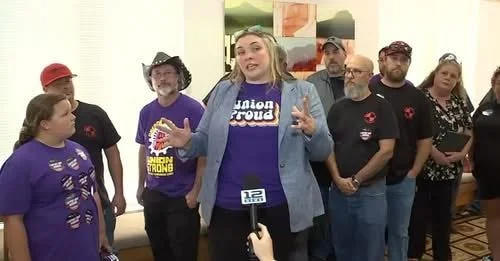
SEIU 503 Executive Director Melissa Unger and union members urge legislators to raise taxes and fees for transportation. (Courtesy SEIU 503)
The political action committee of Service Employee International Union 503, fresh off its failed 2025 effort to impose a gas tax hike rejected by 83% of Oregon voters, donated $400,000 to Gov. Tina Kotek’s re-election campaign in two contributions made late July and early August, according to Oregon’s campaign finance database.
The gas tax debate dominated Oregon politics for the better part of a year, culminating in May with the resounding electoral defeat of Kotek’s top legislative priority. SEIU 503 was one of the most outspoken interest group favoring the six-cents-per-gallon gas tax hike, doubling of vehicle registration fees, nearly tripling title fees, and doubling the payroll tax working Oregonians pay to help fund mass transit.
SEIU 503 represents some 26,000 state workers, including around 2,500 who work for the Oregon Department of Transportation in maintenance, headquarters and DMV positions. The union raises money for its PAC, called Citizen Action for Political Education (CAPE), when its members choose to have their employer, the State of Oregon, withhold a portion of their paychecks to direct those funds to CAPE. CAPE reported raising over $646,000 so far in 2026 and over $1 million in 2025.
Kotek and SEIU 503 have made finding sustainable transportation funding a priority for 2027, potentially setting up another debate over taxes and fees if Kotek wins re-election. The Governor formed a “Rebuilding our Transportation Vision” work group that is developing transportation “funding recommendations” to be delivered to her by the end of this year, according to the Oregon Capital Chronicle.
SEIU 503 pushed hard for the gas tax package throughout its torturous legislative process and urged voters to approve it, but voters overwhelmingly rejected the measure. The union lobbied for the gas tax hike while advocating for “new, sustainable funding” for transportation because “the gas tax is outdated and no longer meets Oregon’s needs.”
Kotek named SEIU 503 lobbyist Anthony Castañeda chair of the work group's Maintenance, Operations, Preservation and Emergency Response subgroup, giving the union a direct role in the process expected to inform the 2027 transportation package.
Kotek’s Republican challenger, Christine Drazan, opposed the tax and fee hike package.
The contributions make SEIU’s PAC, called Citizens Action for Political Education, the second-largest contributor to Kotek this cycle, tied with another union, the Local 48 Electrician’s PAC. Her most generous supporter so far is a PAC of The Democratic Governors Association, which has plowed $2.5 million into Kotek’s campaign in 2026.
The contributions are consistent with past practices. SEIU 503, via CAPE, regularly contributes heavily to Democratic candidates in Oregon, with special attention to the governorship. The governor controls the state side of negotiations with SEIU 503 over state employee contracts, including pay rates. The most recent contract, overseen by Kotek in 2025, gave SEIU 503 member state workers a 6.6% pay increase over two years. CAPE contributed over $750,000 to Kotek’s successful 2022 race, also against Drazan. The winner of the 2026 race will oversee negotiations for a new contract, and possible additional pay raises, in 2027.
But with the 2025-2026 gas tax fight still fresh in voters’ minds, the contributions signal the tax-hiking team of Kotek and SEIU 503 may once again seek more money from taxpayers should Kotek win a second term.
A failed year-long tax fight
Oregon’s 2025-2026 transportation tax fight began with a call for more ODOT funding, complete with threats of layoffs and ended with an overwhelming voter rejection. Throughout the fight, SEIU 503 played a central role in pushing lawmakers to approve additional transportation funding and later fighting the effort to overturn it.
The Legislature spent much of 2025 debating how to fill a projected ODOT funding shortfall. The original transportation package collapsed during the regular legislative session amid opposition to its size and tax increases.
Kotek responded by calling lawmakers back to Salem for a special session beginning August 29, 2025. Her scaled-down proposal, HB 3991, still relied heavily on higher taxes and fees. The package's major gas-tax and vehicle-fee increases were projected to raise roughly $3.8 billion over the following decade.
SEIU 503 strongly supported passage. It organized ODOT workers to lobby legislators, arranged at least 13 meetings between workers and lawmakers, according to the union’s website, encouraged members to testify, and held a rally at the Capitol as the special session began. SEIU later credited its members’ lobbying with changing legislators’ votes and getting the package through the House. The union described passage of the bill as a victory that saved ODOT jobs.
Ultimately, the legislature passed the pared-back version of the tax bill by a one-vote margin in both houses of the legislature. SEIU 503 boasted on its website, “Our union power saved ODOT jobs.” But legislative passage of the tax package would prove a false summit for Kotek and SEIU 503.
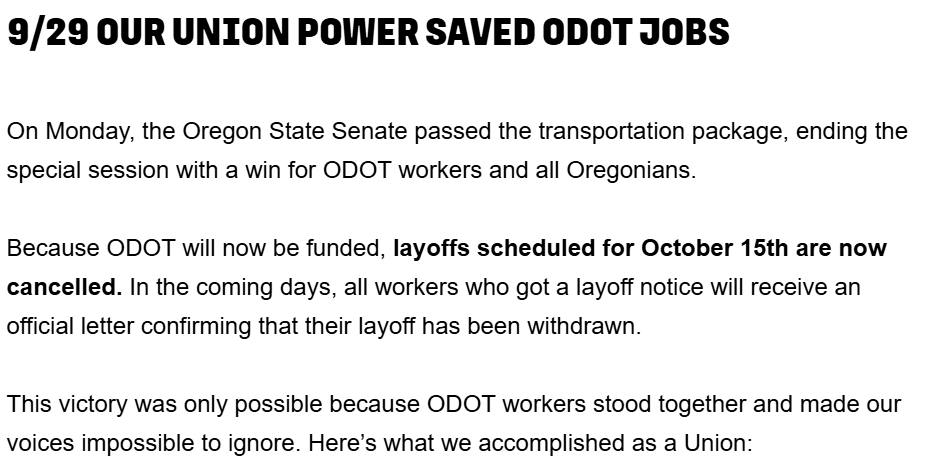
Source: SEIU 503 website
Oregonians were about to weigh in.
Voter backlash
The political fight intensified after passage.
Republican lawmakers and taxpayer activists launched a referendum campaign to prevent the tax increases from taking effect and give voters the final say.
Kotek urged Oregonians not to sign the referendum petition, saying:
Frankly, I would urge Oregonians to think about signing on to a referral that will take away our basic ability as Oregonians to keep our roads operating. We’re going to move forward with the assumption we have this and we have to move forward for the state and we’ll see what happens.
Kotek then waited weeks before signing the tax bill in an attempt to reduce the time signature gatherers had to gather signatures. She finally signed it on November 7, 2025, but her office did not publicly announce the signing until November 10.
The strategy backfired. By November 25, Rep. Ed Diehl reported that organizers had gathered approximately 150,000 signatures, roughly twice the number of valid signatures required.
SEIU keeps tabs on signature gatherers
SEIU’s involvement did not end when the Legislature passed the bill.
Oregon Roundup Foundation obtained an SEIU communication asking members to observe the referendum signature-gathering campaign and report information back to the union. SEIU said it was “closely watching what No Tax Oregon is doing to ensure they will be held accountable to follow the law.”
The union provided members with a form instructing them to “OBSERVE & RECORD, ASK and REPORT BACK” about petition circulators, including details relevant to Oregon’s signature-gathering requirements.
The effort drew criticism from within SEIU itself.
SEIU 503 board member Charlotte Kreftmeyer told Oregon Roundup Foundation that asking union members to monitor people exercising their referendum rights was “deplorable.” She also criticized the union’s close political relationship with the governor, telling ORF, “SEIU is money in Tina Kotek’s pocket.”
Voters have the final word
The referendum eventually put the transportation tax increases before Oregon voters in May 2026.
The result was devastating for the tax package: roughly 83% of voters, and 75% of Multnomah County’s overwhelmingly progressive voters, rejected it, an extraordinary margin for a statewide ballot measure.
It turns out ODOT did not lay anyone off
Despite repeated warnings from Kotek, SEIU 503 and ODOT, not one ODOT employee was ultimately laid off as a result of voters rejecting the tax increases. ODOT nevertheless lost hundreds of workers through attrition during the funding uncertainty, including roughly 350 employees whose departures contributed to vacancies at the agency.
More than two months before voters rejected the tax increases, however, lawmakers adopted a different solution. In March, legislators voted on a bipartisan basis to redirect existing transportation dollars to ODOT operations, an approach Republicans had advocated in lieu of tax increases during the transportation funding fight. The move, urged by Republicans as an alternative to tax increases for months, prevented the threatened layoffs before voters cast their ballots on Measure 120.
The threat of layoffs remains. ODOT says the agency is again preparing reduction plans for the 2027–29 budget cycle and has warned that layoffs could return if lawmakers don't address its long-term funding shortfall.
If Kotek wins re-election with substantial financial support from SEIU 503, Oregonians can expect another round of debate over tax and fee increases to fill that “funding shortfall.”
Oregon Roundup Foundation created this article. ORF is a 501(c)(3) nonprofit corporation dedicated to covering Oregon political and government news. Media outlets are welcome to use this article for free with attribution of the author and Oregon Roundup Foundation.