
First Aimee, Still
Two years after a staff revolt, new emails show Kotek’s wife retaining substantial policy influence and support from the governor’s top aides
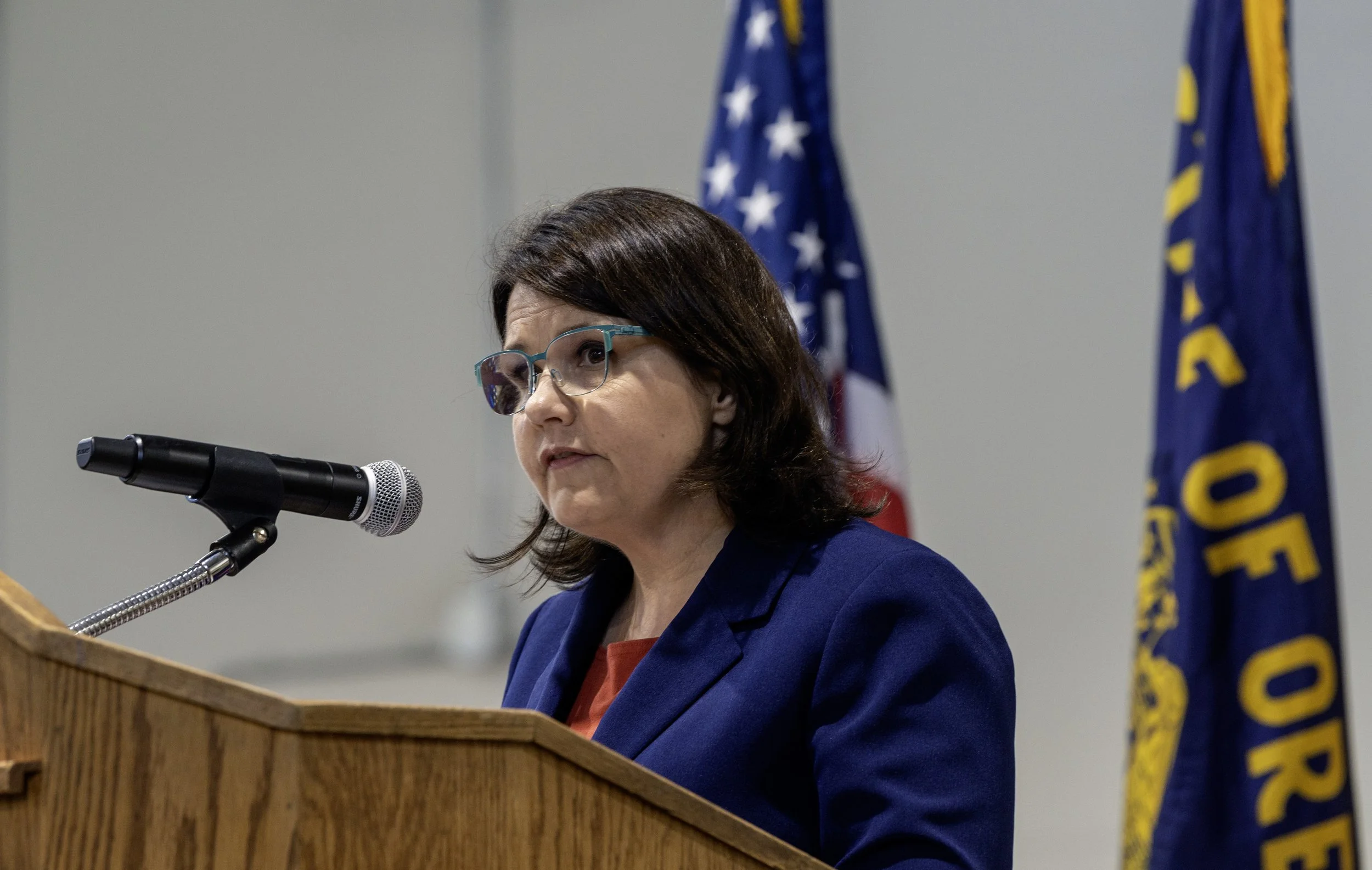
First Lady Aimee Kotek Wilson speaks at a Corvallis Armory ribbon-cutting ceremony on August 20, 2026. (Photo by John Hughel/Oregon National Guard - CC BY 4.0)
Oregon Governor Tina Kotek provided her wife, Aimee Kotek Wilson, with office space in the Governor’s suite, far-reaching support from her top staff, state police protection and the power to provide strategic direction for her administration’s approach to the state’s mental health and addiction crises during the first half of 2026, according to email records obtained from the Governor’s office by Oregon Roundup Foundation (ORF) via public records request.
The emails depict a First Lady role materially similar to that which led to a senior staff revolt and drew public concern in early 2024, forcing Kotek to abandon plans for a formal office of the first spouse and apologize to Oregonians.
In 2024, Kotek’s then-chief of staff Andrea Cooper and two other senior staffers, Deputy Chief of Staff Lindsey O’Brien and Special Advisor Abby Tibbs, abruptly left the Governor’s office over concerns about Kotek Wilson’s role in policy matters, the use of state police to drive Kotek Wilson to events without the Governor, and protect her there and “conflicts of interest, favoritism, bias, nepotism issues, complicated power dynamics, conflict resolution, retaliation – the things that can really impact [governor’s office] staff morale and sense of stability and the confidence in a [governor’s office] overall,” Tibbs wrote in an email shortly before she left the Governor’s office.
Governor’s office emails between January 1 and June 2, 2026, show Kotek Wilson’s role has, if anything, grown since the 2024 staff shakeup that forced Kotek to apologize to Oregonians for her handling of her wife’s role. Earlier this year, Kotek Wilson received reports about the performance of her Instagram account, begun in 2025, had standing weekly meetings with Kotek’s Chief of Staff Chris Warner, who left the job in June, and other top Kotek staffers, and frequently communicated with two Kotek deputy chiefs of staff, the Governor’s policy staff, her own scheduler, Kotek’s executive assistant and, less frequently, with other senior staff on a wide range of policy and administrative matters.
In 2026, Kotek Wilson’s power did not, based solely on the emails produced to ORF, cause staff concern, like it did in 2024. Instead, the new crop of senior staff led by Chie of Staff Chris Warner and Deputy Chiefs of Staff Taylor Smiley-Wolfe and Vince Porter, appears to have fully embraced Kotek Wilson’s role. Staff frequently referred to her as “First Aimee” in emails to her, accommodated her requests and appeared eager to help. Warner and Smiley-Wolfe have both subsequently left the Governor’s office, but, unlike the 2024 staff shakeup, there is no indication in the produced emails their departures were related to Kotek Wilson.
However, if Oregonians were concerned in 2024 about Kotek Wilson’s power in her wife’s administration (Willamette Week reported in May 2024, “In many ways, [Kotek Wilson] is Oregon’s co-governor, although she rejects that premise.”), and not staff’s negative reaction to it, the emails are unlikely to disabuse them of that concern as Kotek squares off in a rematch with Republican challenger Christine Drazan in a race polling suggests is far from decided.
Kotek in 2024: “I apologize to Oregonians that I haven’t been as good as I could be at making this a smooth conversation.”
Soon after news broke of the staff departures over Kotek Wilson’s role, Kotek addressed the issue in a May 1, 2024, press conference. She laid out three guardrails on the First Lady position: “there will not be an office of first spouse; there will not be a chief of staff to the first spouse; and other than staff that is assigned to support the first lady in her official duties, no staff will report to her or be supervised by her.”
Kotek’s office inquired with the Oregon Government Ethics Commission regarding the permissibility of Kotek Wilson’s role as a volunteer in her wife’s administration. Unsurprisingly — Oregon ethics laws enforced by OGEC apply when someone is making money, which Kotek Wilson appears not to be — OGEC responded that Kotek Wilson’s role as presented to it by the Kotek administration did not violate Oregon ethics laws. The OGEC dismissed the matter after the commission deadlocked 4-4 on the question of whether to launch a wider investigation into Kotek Wilson’s role.
Prior to the 2024 staff shakeup, Kotek and Kotek Wilson had explored the creation of an office of the first spouse, even borrowing a staffer from another state agency to help form the office and act as Kotek Wilson’s chief of staff. During the press conference, Kotek said, “Oregonians have been very clear, ‘that’s a little too much for us.’”
Meliah Masiba, the staffer brought into the Governor’s office to help create an office of the first spouse and act as Kotek Wilson’s chief of staff, was redirected in the midst of the 2024 fracas to drafting a First Partner Handbook. The Handbook did not, as suggested by Kotek during her May 2024 press conference (“Once we figure this out with more guidance, we’ll be back with more answers.”), provide significantly more detail about the boundaries of the First Lady role. It recites the role of the Oregon State Police Dignitary Protection Unit to “protect the First Spouse/Partner and immediate family from threats” without specifying which appearances or activities warrant a security detail. It reiterates the OGEC guidance. It provides that “the size and role of staff assigned to support and work with the First Partner will vary based on how they choose to engage as a volunteer to support the Governor’s agenda.”
The 2024 controversy and its aftermath provide a lens, if an imperfect one, through which to view Kotek Wilson’s role in her wife’s administration in early 2026. There is no office of the first spouse, but Kotek Wilson has a physical office in the Governor’s suite. There is no chief of staff to the First Lady, but senior Governor staff, particularly Deputy Chief of Staff Taylor Smiley-Wolff, performed many of the functions a chief of staff would perform for her principal. There is no indication from the emails that staff officially reported to Kotek Wilson or were officially supervised by her, but significant top-level staff resources were dedicated to effectuating Kotek Wilson’s strategic policy vision, meetings and event attendance. Kotek Wilson asked for and received changes to the way staff supported her.
Meanwhile, in the space between the Kotek-established boundaries, the First Lady’s role and staffing, security and other resources supporting that role, continued apace.
First Lady provided her wife’s administration with “strategic direction” on addiction and mental health policy
Kotek Wilson’s policy efforts in the first half of 2026 largely focused on “behavioral health,” a term the state uses to describe efforts to combat addiction and mental illness, two areas in which Oregon has particularly struggled before and during Kotek’s term. Oregon has some of the nation’s highest substance use disorder rates and had the highest estimated prevalence of adult mental illness among the states, according to Mental Health America’s 2025 report, based on 2022–23 data.
As she had early in Kotek’s term, Kotek Wilson in early 2026 participated in behavioral health policy conversations in the Governor’s office, aided by Kotek’s appointment of her to chair the newly created Behavioral Health Talent Council in May 2025. In appointing her wife to chair the BHTC, Kotek emphasized, as she did in explaining Kotek Wilson’s role early in her term, Kotek Wilson’s previous role as a social worker.
According to Oregon Public Broadcasting, Kotek Wilson held an Oregon social worker license for less than two years, between early 2021 and the end of 2022, working for Cascadia Behavioral Health during that time. She obtained a masters degree in social work from Portland State University in 2017. Before attending PSU, Kotek Wilson had worked in Democratic and union politics since 2000.
Kotek said she formed the BHTC to formulate a work plan “by January 31, 2026” to expand upon an earlier state agency report identifying ways Oregon can train and retain behavioral health workers. The appointment provided Kotek Wilson a platform around which to organize her behavioral health policy work for her wife’s administration.
Emails reveal Taylor Smiley-Wolfe, Kotek’s Deputy Chief of Staff for Governor’s Initiatives and one of three members of “the chiefs,” the staff term for the trio of Kotek’s highest-ranking staff members, took the lead staffing Kotek Wilson’s BHTC work. Smiley-Wolfe left Kotek’s office in April.
In connection with BHTC’s work, Smiley-Wolfe and other Kotek senior staff ensured Kotek Wilson had the talking points, remarks and other staff assistance. Elisabeth Shepard, then Kotek’s communications director, emailed Kotek Wilson, Smiley-Wolfe, Chris Warner and Kotek herself February 2 with an updated draft of Kotek Wilson’s testimony about the BHTC report before the House Committee on Behavioral Health scheduled for the next day: “See attached version with a few items underlined based on our practice this morning.”
The BHTC held its final meeting in late January; its agenda included approval of sending the final report to Kotek. Kotek Wilson and staff held a reception celebrating completion of its report on February 18. The Governor’s office announced receipt of the report in a press release dated February 20.
But Smiley-Wolfe’s direct work with Kotek Wilson did not end with the conclusion of the BHTC. She helped develop the “First Lady’s Public Affairs Plan,” which emails suggest contained a plan of action to implement behavioral health reforms. On March 27, after Smiley-Wolfe announced her departure from Kotek’s office, she emailed five Kotek staffers, identified in the email as “project leads” on the Public Affairs Plan, urging them to contact Smiley-Wolff’s replacement “to get the time you need with the First Lady to ensure you are advancing this work in alignment with her strategic direction.”
In a March 19 email, Smiley-Wolff confirmed weekly staff check-ins on BHTC, even “with the council being over[.]” Those BHTC check-ins would be staffed by four Kotek staffers, according to the email.
The Governor’s office did not produce the First Lady’s Public Affairs Plan to ORF, and has not responded to a follow-up request to produce it. However, the emails show part of the plan was to identify and court outside interest groups to support policies to implement the BHTC report. On March 17, Kotek’s Behavioral Health Initiative Director Amy Baker emailed other top staff about a scheduled Kotek Wilson meeting with the Association of Oregon Community Mental Health Programs, during which the First Lady would attempt to “garner their support for future asks moving forward such as legislative action/budgetary asks[.]” Baker and KC Ledell, Kotek’s Senior Behavioral Health Advisor were both planning to staff Kotek Wilson during the meeting, according to the email.
The same day, Smiley-Wolfe emailed senior staff about a meeting between Kotek Wilson and the American Federation of State, County and Muncipal Employees (AFSCME). The email explains the meeting was with State Representative Lamar Wise (D-Portland), who is also the Director of Special Projects for AFSCME: “Rep Wise is back on BH work for AFSCME so this meeting will be with him and AFSCME,” Smiley-Wolfe wrote.
BHTC was not the only item on the AFSCME meeting agenda. Smiley-Wolfe suggested Kotek Wilson ask AFSCME, a supporter of Kotek’s re-election campaign, about the closure of homeless shelters operated by the nonprofit Sunstone Way in Portland. AFSCME represented affected shelter workers and fought to keep the shelters open in spite of concerns about nonprofit governance and finances.
First Lady met with lobbyists and attended events without the Governor but with state police security and staffing
Kotek Wilson’s role in the Governor’s office extended beyond BHTC and behavioral health generally. Her position of leadership in the office is perhaps best summarized in a March 5, 2026, email from Kotek communications director Elisabeth Shepard to Chief of Staff Chris Warner, confirming she was leaving state employment to work for U.S. Representative Janelle Bynum (D-OR): “Working alongside Governor Kotek and First Lady Kotek Wilson has been an incredible honor, and Oregon is lucky to have their enduring leadership.”
In February, Deputy Chief of Staff Vince Porter greenlit a meeting between Kotek Wilson and Confederated Tribes of the Grand Ronde lobbyist Martha Pellegrino and chief of staff Stacia Martin. Pellegrino wrote that she requested the meeting with the First Lady primarily for “relationship building and connecting around shared priorities,” without a specified narrower focus. The Tribes operate Spirit Mountain Casino, which bills itself as Oregon’s largest casino, as well as mental health and addiction programs.
Kotek Wilson attended a March 13 Trail Blazers game featuring a “Celebration of Women’s History,” during which Kotek Wilson helped pass a basketball down from the upper levels of the arena to the floor, and met NBA Commissioner Adam Silver. State police provided security for the First Lady at the event, with staff emailing about the logistical challenge of having police perform advance work at the Moda Center two days before the game. Porter, Kotek’s Deputy Chief of Staff, volunteered to staff Kotek Wilson at the game and during the Women’s History portion of the event.
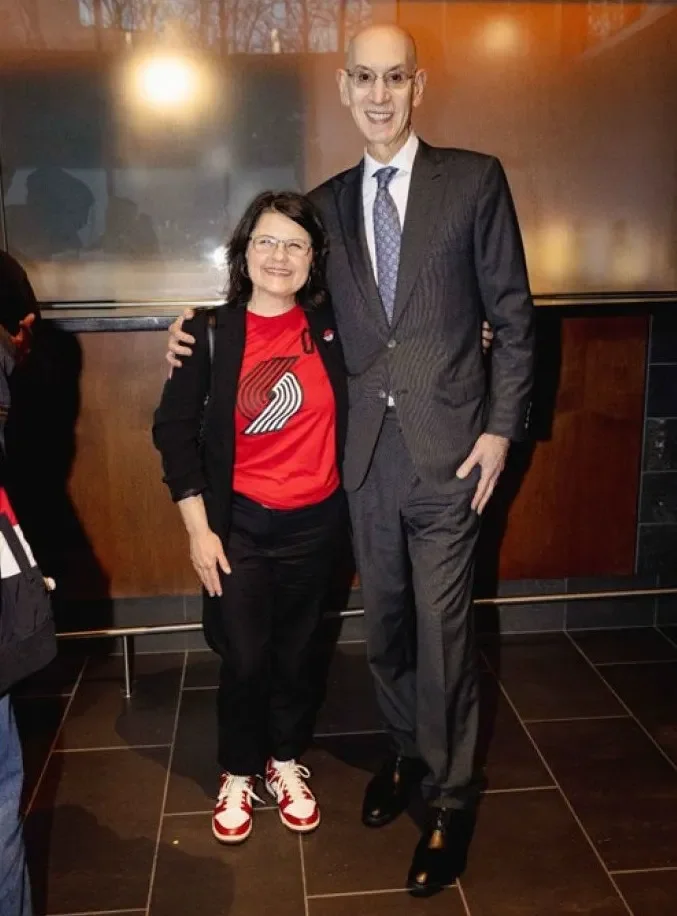
First Lady Aimee Kotek Wilson with NBA Commissioner Adam Silver at a Women’s History Celebration at a Trail Blazers game March 13. (Photo by Governor’s office staff, provided to Kotek Wilson for approval for use on her social media accounts, and produced to ORF in response to public records request).
The emails show Kotek Wilson’s interested in a range of events, including plans to attend the Affiliated Tribes of Northwest Indians at the downtown Portland Hilton, with a registration fee of $250, and a reception honoring the birthday of the Emperor of Japan, also at the downtown Hilton, that Genevieve Ziebell, the Governor’s executive assistant and scheduler, said would require “at least two if not three staffers . . . Make sure someone is dedicated to FL,” short for “First Lady.” The Governor did not attend the event.
In January, the Governor, First Lady and staff moved back into the Governor’s suite of offices, suite 254, following extensive renovations to the Capitol Building. Jane Cigarran emailed another staffer to ask that a hexagonal table be removed from “FL office,” and that a new table be constructed for the First Lady’s office: “I believe a work request was put in but I’m not sure if we’ve received a response.” The facility services manager for the capitol emailed back less than an hour later, “We will have the table assembled by the end of the day today.”
Kotek Wilson now has an official, state-maintained Instagram account, with the first post appearing May 27, 2025. Throughout the first half of 2026, Kotek Wilson received updates on the performance of that account, distinct from Kotek’s official and campaign accounts. Seay reported monthly to Kotek Wilson with data including total followers “185 (183% increase from the following [sic] month,” page interactions and other metrics. “The First Lady’s content is significantly outperforming industry standards, indicating the content is engaging and is resonating deeply with our target audience,” Seay wrote in her March 3 report.
ORF contacted the Governor’s spokesperson for comment for this article, but received no response.
Enduring influence
After the tumult of 2024, Kotek abandoned plans for a formal office of the first spouse and a dedicated chief of staff. But the 2026 emails show her wife continuing to provide strategic direction on behavioral health initiatives, supported by senior staff, office space and state police protection. Where earlier aides raised objections, the correspondence reviewed shows their successors organizing and supporting her work.
As Kotek seeks a second term, the records give Oregonians a clearer picture of the arrangement that survived the controversy: the proposed office was dropped, but the First Lady retained substantial influence and the staff support to exercise it.
Oregon Roundup Foundation created this article. ORF is a 501(c)(3) nonprofit corporation dedicated to covering Oregon political and government news. Media outlets are welcome to use this article for free with attribution of the author and Oregon Roundup Foundation.