
La Mota Plays On Under Kotek’s New Tax Rules
Millions in tax liens haven't stopped the politically connected cannabis retailer. Kotek's 2023 reforms help explain why.

Gov. Tina Kotek (then a candidate) plays pickleball with La Mota founder Aaron Mitchell at an August 2022 fundraiser. (Photo: Andie Petkus Photography)
Three years after revelations that its owners delivered campaign contributions to prominent Oregon Democrats in brown paper bags, hired the sitting secretary of state as a consultant, and failed to pay hundreds of thousands of dollars in taxes, cannabis retailer La Mota continues to operate dozens of stores across Oregon despite new tax-compliance rules ordered by Gov. Tina Kotek in response to the scandal.
The fallout from the brazen, cash-fueled influence campaign conducted by La Mota owners Aaron Mitchell and Rosa Cazares, a story broken by Willamette Week in 2023, grabbed public - and affected Democrats’ - attention. Secretary of State Shemia Fagan, who was on the payroll of a La Mota-affiliated company owned by Mitchell and Cazares, resigned over revelation she earned $10,000 per month from Mitchell and Cazares helping secure new cannabis licenses outside Oregon while her state office conducted an audit of state cannabis regulations.
La Mota, Mitchell, Cazares and a political action committee controlled by Cazares donated $68,365, in cash, to Tina Kotek during her 2022 gubernatorial campaign, holding three fundraisers for her during the campaign. After the Fagan news broke in 2023, Kotek donated $75,000 to her former employer, Oregon Food Bank, symbolic of the political radioactivity of La Mota at the time.
Kotek also announced new rules requiring a cannabis retailer to show it is Oregon tax compliant to obtain or renew a license. She said the rules would ensure retailers were “not getting any competitive advantage if they haven’t paid their taxes.”
Yet, in the summer of 2026 alone, Oregon's Department of Revenue issued more than $7.9 million in tax liens against La Mota owner Aaron Mitchell and dozens of affiliated companies, according to public records reviewed by Willamette Week. Marion County records show the Department of Revenue issued four marijuana-tax distraint warrants, legal documents allowing the state to seize the property of a delinquent taxpayer, against Rosa Cazares between April 2025 and July 2026, totaling more than $455,000. Two warrants totaling approximately $302,000 remained unsatisfied as of August 29, 2026. Both were subsequently satisfied.
Cazares appears, as of yesterday, on the Department of Revenue’s online “delinquent taxpayer list,” for nearly $155,000 in delinquent marijuana taxes owed by La Mota and four affiliated companies that operate retail outlets in Oregon.
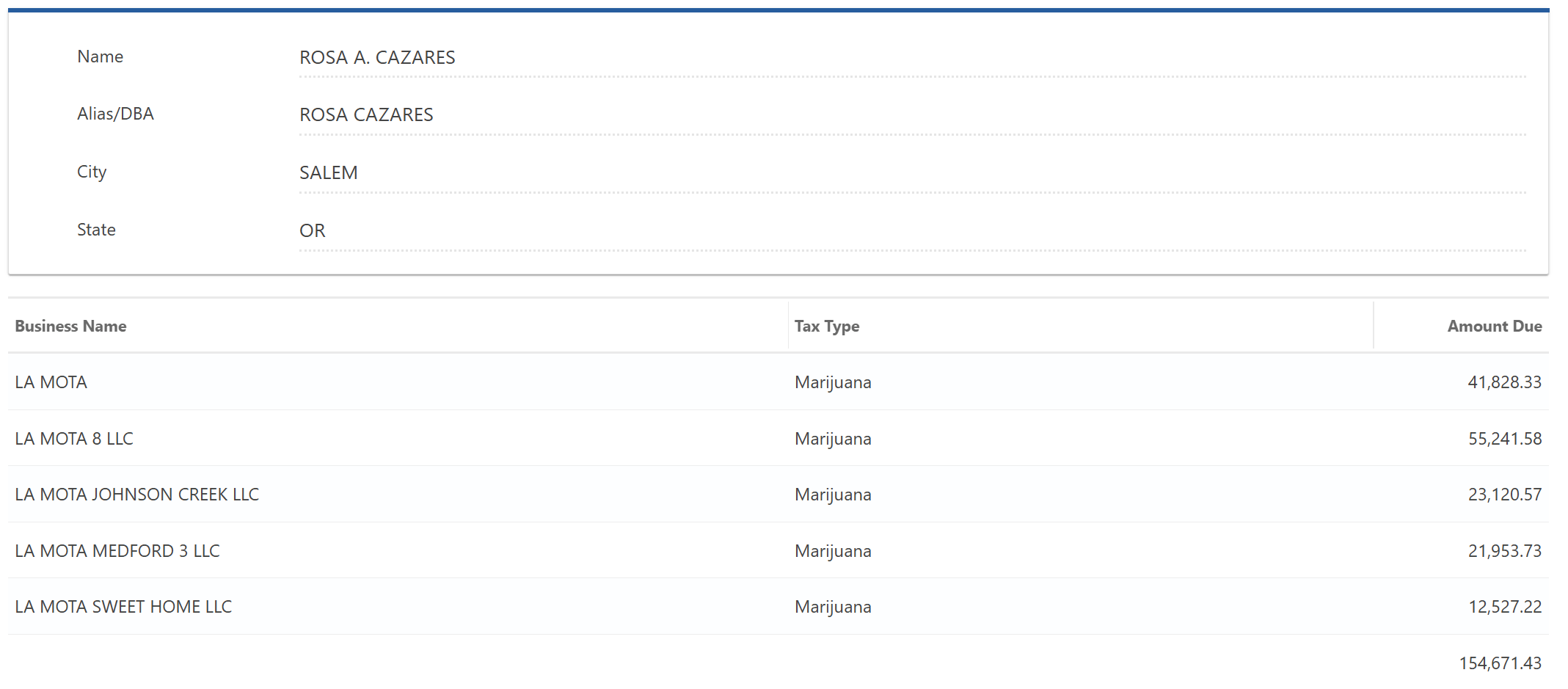
Screenshot of DOR’s Delinquent Taxpayer List, taken October 12, 2026.
The new rules allow delinquent taxpayers to continue to sell marijuana if they are on a payment plan, even if the amount of total delinquent tax debt continues to increase
Kotek’s 2023 changes required cannabis retailers and their qualifying owners to obtain Department of Revenue certificates demonstrating compliance with state and local taxes administered by the department before obtaining or renewing retail licenses. But the new rules included a significant qualification: Retailers with outstanding tax debts could still obtain certificates if they had filed their returns and were complying with DOR-approved payment plans.
The compliance scheme led to Cazares being listed publicly by DOR as a delinquent taxpayer in the same month it certified her as tax compliant for the purpose of renewing LaMota-affiliated cannabis licenses:
On August 5, 2026, DOR certified Cazares as tax compliant even though the department had issued two still-pending marijuana-tax warrants, with original amounts totaling approximately $302,000 against Cazares, according to Marion County records. Cazares submitted the tax certificate to renew or obtain six different cannabis licenses for six different La Mota-affiliated companies operating six different retail outlets.
As of August 29, Cazares was included on DOR’s delinquent taxpayer list. It is unknown when she was first added; citing privacy laws, DOR declined to say. As of August 29, the two marijuana tax warrants remained pending against Cazares, according to Marion County records.
Cazares got the license renewals with the tax warrants pending, and subsequently satisfied the two remaining warrants.
DOR, citing privacy laws, declined to discuss the specific tax situation of La Mota, Cazares or Mitchell, or how La Mota continues to operate in spite of tax liens and warrants and Cazares’ presence on the department’s own delinquent taxpayer list.
“Both the Delinquent Taxpayer List, which is updated nightly, and tax compliance certification represent a point in time. The department follows the requirements in statute for when a taxpayer is added to the Delinquent Taxpayer List and for when a taxpayer is certified as compliant,” DOR spokesperson Robin Maxey wrote in an email to Oregon Roundup Foundation.
Cazares did not respond to ORF’s question about whether she is or has been on a DOR payment plan. If she was, that could explain DOR issuing tax compliance certificates to her despite significant delinquent tax debt. However, her participation in a payment plan would also prevent her from appearing on the delinquent taxpayer list by August 29. DOR’s website says taxpayers won’t be put on the list if they are party to a payment plan, and will be removed if they enter into a payment plan after they land on the list.
One possible explanation is that Cazares and related entities were current, including any payment plans, on all state taxes as of August 5, but had defaulted or incurred new delinquent tax debt as of August 29 when she appeared on the delinquent taxpayer list and remains to this day. DOR declined to confirm this potential explanation.
Still, Kotek’s new rules have allowed La Mota to continue to renew cannabis licenses while the amount of state taxes he owes based on publicly recorded tax liens has increased dramatically. In 2023, Willamette Week reported Oregon had issued $1.8 million in tax liens against Mitchell, Cazares and their La Mota-affiliated companies. Three years later, WW reported the state had issued more than $7.9 million in new liens against Mitchell and dozens of his companies in just three months.
All the while, relying on the rules enacted in response to the myriad La Mota scandals in 2023, DOR continued to issue tax compliance certificates, and OLCC continued to renew the licenses of La Mota, Mitchell, Cazares and their affiliated companies.
La status quoa
That La Mota, Cazares and Mitchell continue to operate in Oregon despite their well-publicized tax delinquency and attempts to influence Oregon state government is consistent with a marked lack of consequences for others involved.
Fagan resigned as Secretary of State, but later regained her license to practice law despite the ethical lapse of taking a job from La Mota while she oversaw an audit of regulations of La Mota on behalf of Oregon taxpayers. She paid a $3,600 fine ordered by the Oregon Government Ethics Committee after she made approximately $20,000 from the La Mota affiliate for two months of consulting before the scheme became public.
A federal investigation into potential criminal charges against Fagan, La Mota, Mitchell and Cazares, commenced in 2023, was terminated December 20, 2024. That day, in the waning weeks of the Biden administration, then-U.S. Attorney General Merrick Garland visited the U.S. Attorney’s office in Portland. Garland and Wright held a press conference in the morning. By 3:13 pm, Fagan’s attorney emailed, “I wanted to let you know that I just heard that the investigation by the U.S. Attorney’s Office is being closed and that no charges will be brought against Shemia.”
Oregon Roundup Foundation created this article. ORF is a 501(c)(3) nonprofit corporation dedicated to covering Oregon political and government news. Media outlets are welcome to use this article for free with attribution of the author and Oregon Roundup Foundation.